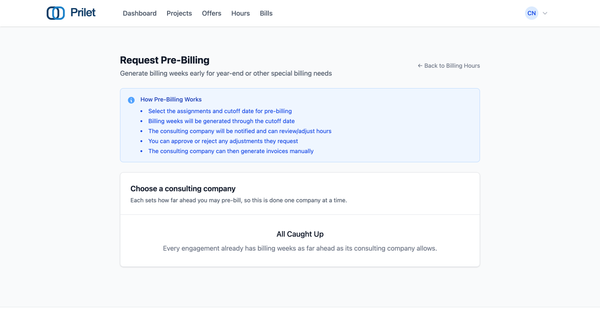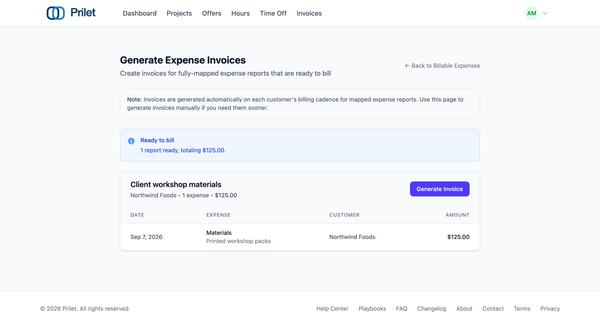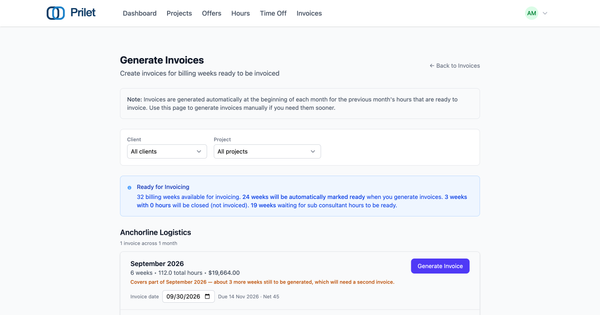
Your hours now arrive filled in, day by day

A billing week used to be a single number, and that number was the only thing you could argue with. If the week added up but the days inside it did not, there was no way to say so.
Your hours now arrive filled in, day by day
A billing week used to be one number. If you worked four hours on the Wednesday and made them up on the Saturday, the only way to say so was to change the week's total — which, since the total had not moved, meant there was nothing to say at all.
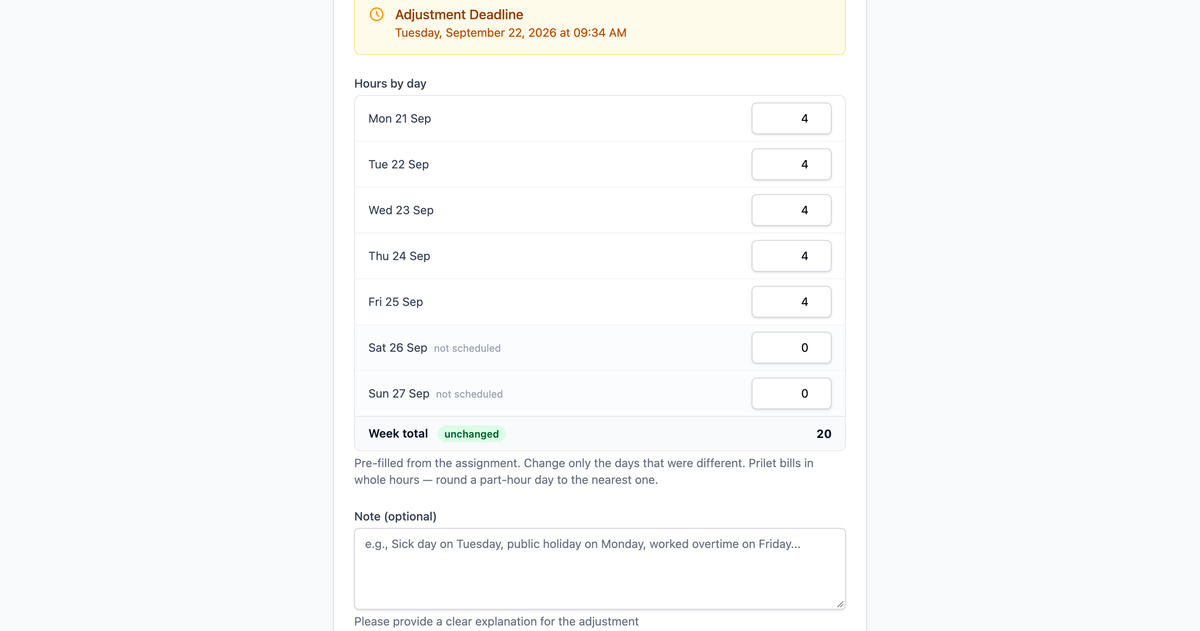
Every week now arrives with each day already filled in from your assignment: your hours per day across your working days, less any public holiday or booked time off, laid out date by date. A week that went to plan still needs nothing from you. When one day was different, you change that day rather than restating the week.
Every day is yours to correct, including the ones your assignment does not schedule. Worked a Saturday, or a public holiday? Type over the zero.
Rearranging a week no longer interrupts your client. If the days move but the total does not, nothing they owe has changed and the week simply saves — no approval request, no 48-hour clock. Where the total does move, it goes to them as before, and now shows which day it was.
Invoices are unchanged: still one line per week, still one total.
Invoices are grouped by project, with your own reference
Every invoice — hours or expenses, on screen and in the PDF — now groups its lines by project, then by the person doing the work. Your own reference for that project, the PO or SOW number you maintain, sits on the project heading where AP looks for it.
The arrangement is the same every month, whether the invoice covers one project or five, so nothing moves around on you. Where an invoice does span several projects, each gets a subtotal; where it covers one, it does not, since that would just restate the total underneath.
The spreadsheet export stays one row per line, with project, reference, assignment and consultant as columns, so it still filters and pivots.
Both sides see the same arrangement — the firm that raised the invoice and the client paying it — so a conversation about a line is a conversation about the same line.
Also shipped
- A day that is both a public holiday and booked time off is now deducted once rather than twice. Weeks with such a day were billing less than they were worth.
- Hours are whole numbers throughout. Assignments have always been set in whole hours per day, and adjustments now match.
- In Reports, a consultant's name is now a filter, the same as a project or a client already was.
- Reports group by Status as well as by client, project and consultant — pending, adjustment requested, approved, auto-approved, rejected, ready to invoice, invoiced — and clicking any of them filters to it. On the client side this separates what you have been billed for from work still on its way.