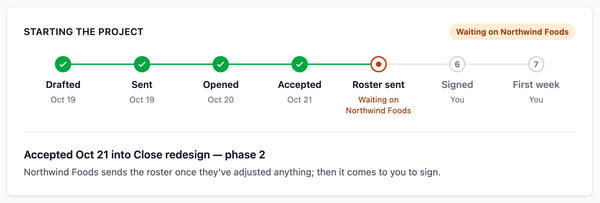
See whose move it is on a new project or sub
Starting a project or bringing on a subcontractor takes moves from several companies, and stalls happen in the gaps. Both sides now see the same steps, and which of them is waiting on whom.

Starting a project or bringing on a subcontractor takes moves from several companies, and stalls happen in the gaps. Both sides now see the same steps, and which of them is waiting on whom.
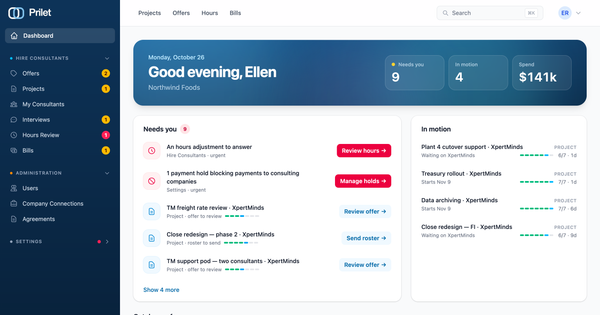
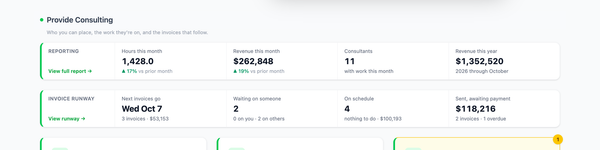
Prilet now has a menu down the left of every page, with counts beside each item, and a dashboard that opens on what needs you instead of a wall of tiles.
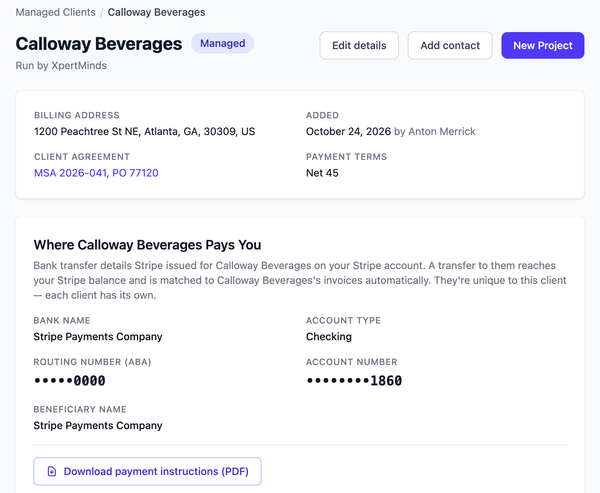
Add a client whose procurement rules rule out a vendor login as a managed client, and run its hours, invoices and payments through Prilet while its people stay informed by email.
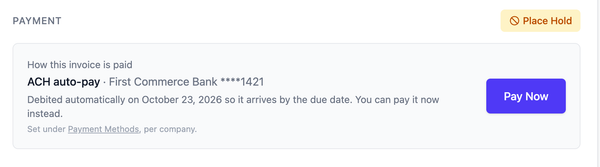
Set how many business days before the due date ACH auto-pay debits, so the money arrives on time instead of days after it.
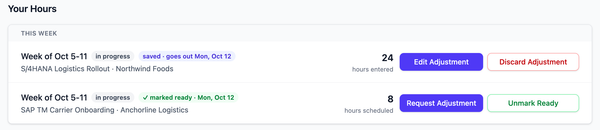
You can now adjust the current week, or mark it ready to invoice, before it closes — the client sees nothing until it does.
Press ⌘K or "/" on any page and jump straight to the invoice, client or page you have in mind.
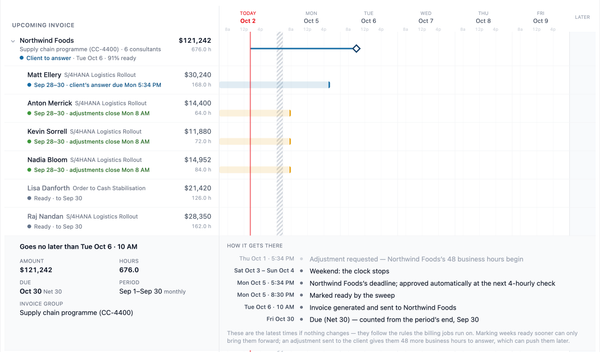
The invoice runway shows when each upcoming invoice will go out, and what — or who — it's still waiting on.
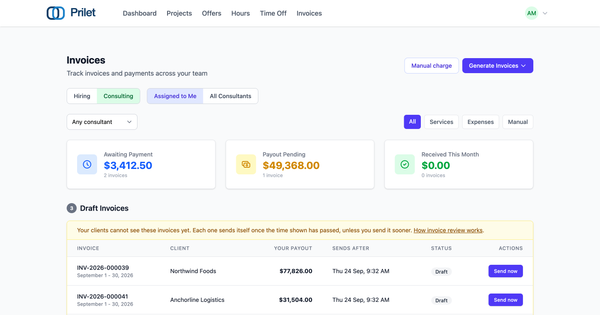
Invoices can now be created as drafts the client never sees, sending themselves two business days later unless you send them sooner.
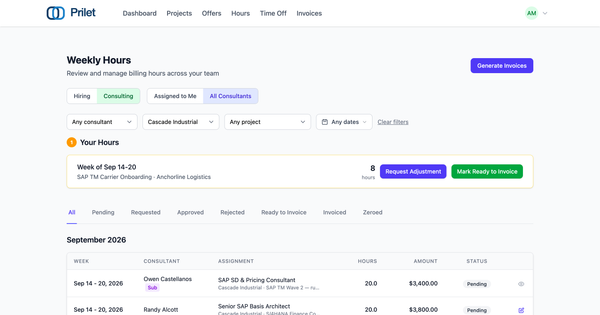
The weekly hours list now filters by client, project and date range, on both sides of the relationship, so you can jump straight to one week.
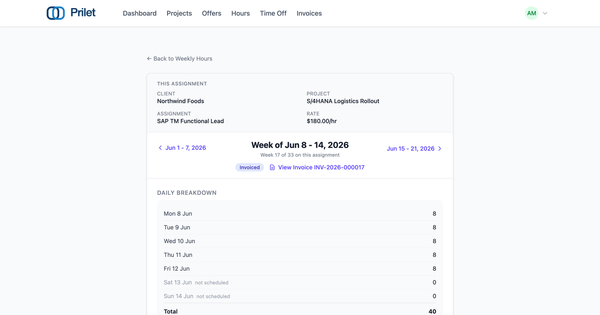
A week's page now leads to the ones beside it, so you can check a run of hours without going back to the list.
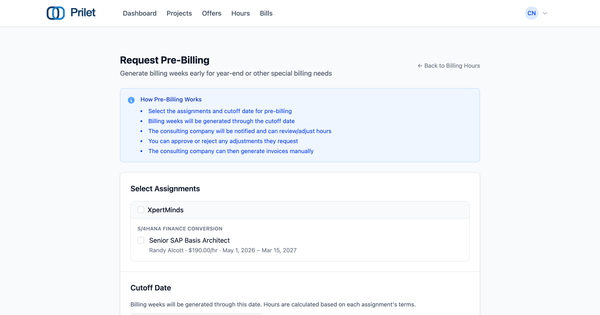
Two related changes this week, both from the same request: a client wanted to close their books in one calendar year for work that runs into the next. Bill ahead of the work, as far as you've agreed to A client closing their books in December for work
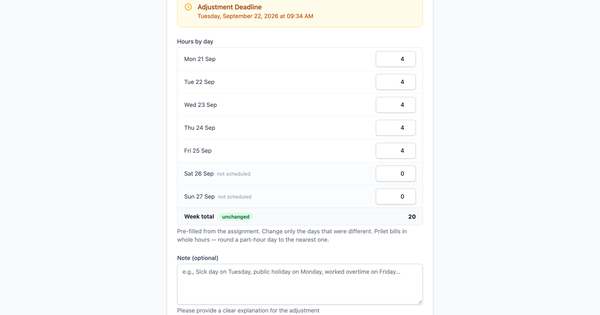
A billing week used to be a single number, and that number was the only thing you could adjust. If the week added up but the days inside it didn't, there was no way to say so. Your hours now arrive filled in, day by day If you
Changelog
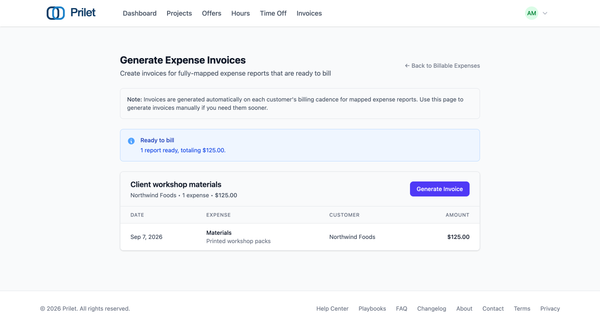
Expenses don't arrive on the same rhythm as hours. A flight booked in August might not get routed for billing until September — and until now, the invoice went out the moment it was mapped, landing on a client mid-month and out of step with everything else they

Changelog
A subcontractor is a company you pay, and a company you pay needs an address — on the invoice, in the remittance, in your books. Until now that address had to live somewhere else. Subcontractors sign in to Prilet as themselves, but most hold an address on your domain and use
Changelog
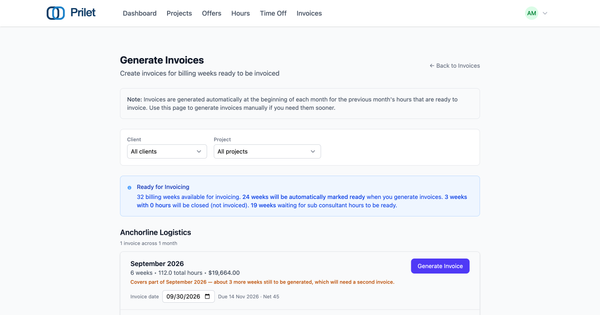
Raising an invoice by hand is the exception path — a client closing their books early, a month you need to bill before the automatic run gets to it. The date on that invoice decides the due date, the QuickBooks posting, and the year its number is drawn from, so it
Changelog
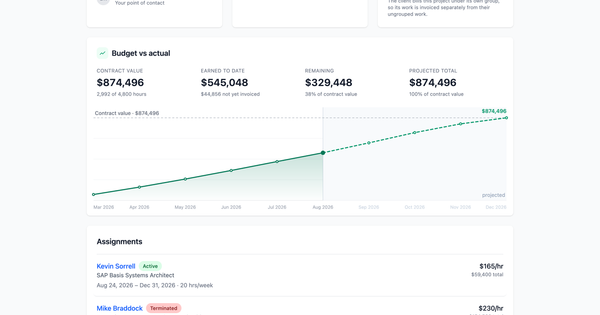
A project has a budget. Knowing whether you're inside it shouldn't require exporting anything to find out. See what a project has spent against its budget A project with a contract value now shows Budget vs Actual: what's been earned to date, where the
Changelog
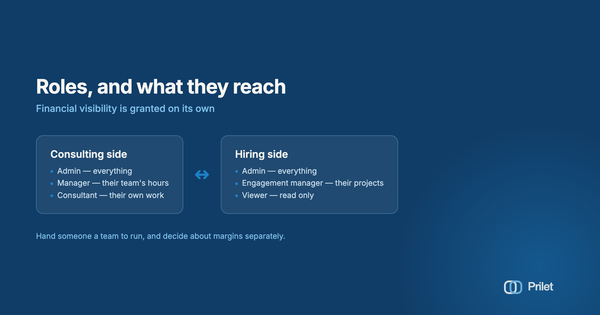
Prilet has two sides and several roles on each, and until now what a given person could see was a set of rules written one screen at a time — the kind of thing that quietly drifts. Access now follows the work rather than the job title. A manager sees the
Changelog
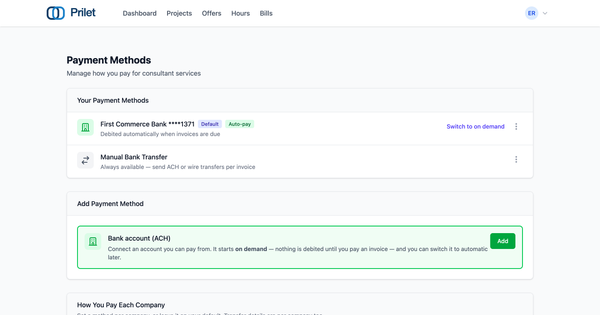
Saving a bank account and authorising somebody to debit it are two different decisions. Treating them as one is how a client ends up automatically charged for something they meant to review first. Choosing which bank account pays an invoice no longer means visiting settings first — the choice sits on
Changelog
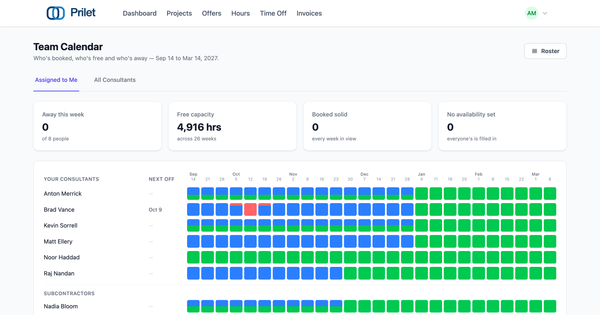
A manager's question is rarely about one person. It's who is free in November, who is away when the next phase starts, and whether the team can take on the work being discussed this week. See a team's whole month at once A calendar

Changelog
A good consultant is rarely exclusive. They might be on your bench and on another firm's, placed through whichever finds the work first — and Prilet used to assume that couldn't happen. A subcontractor can now hold arrangements with several primes at once and be placed by
Changelog
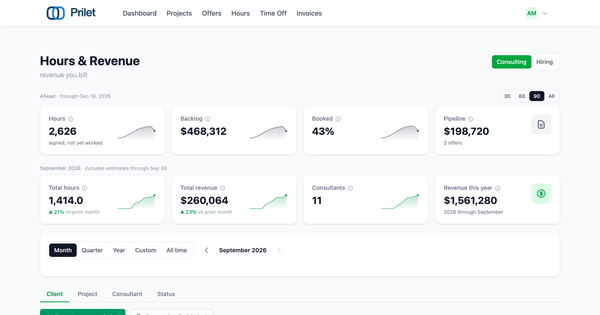
Most reporting tells you what already happened. The more useful question for a consulting firm is what's already committed — how many hours are booked, against how much revenue, for the rest of the year. The Reports page now carries a rolling year beside each headline number: hours and
Changelog
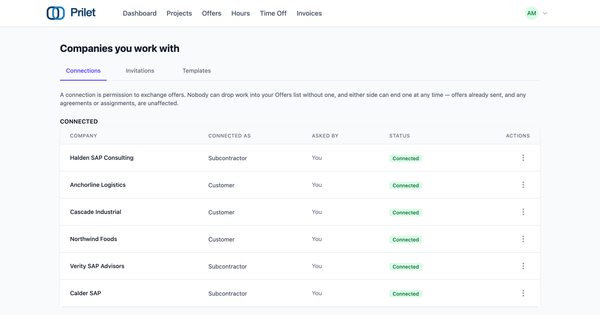
Who you work with used to be inferred from the letters you'd exchanged — an invite sent, an assignment proposed, whatever else implied two companies knew each other. There was nowhere that just said so. A connection is now a thing in its own right: permission to exchange offers
Changelog
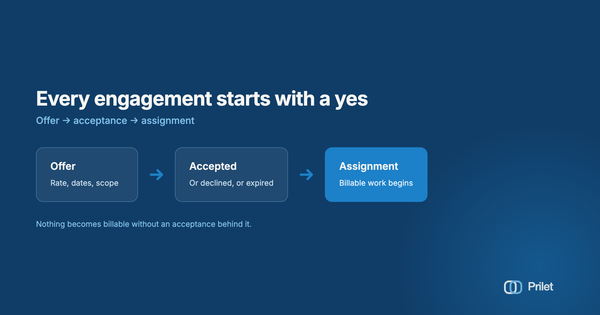
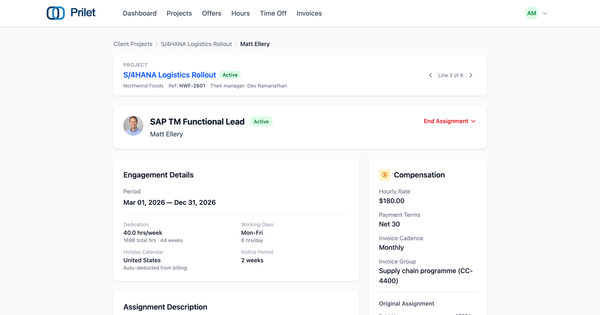
Work shouldn't appear on somebody's calendar without their having agreed to it. Every engagement in Prilet now begins with an offer that the other side accepts, declines, or lets expire. There used to be several ways an assignment could come into being, which meant several places
Changelog
An assignment ending is rarely a surprise to the calendar and often a surprise to the people on it. Both sides now hear about it while there's still time to do something. Both sides are warned before an assignment runs out An assignment reaching its end date now